The Politically Incorrect Guide to the Founding Fathers by Brion McClanahan
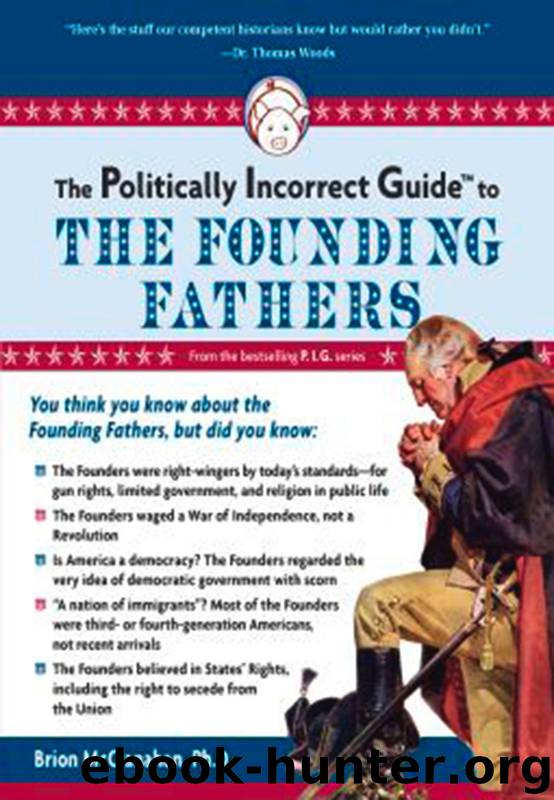
Author:Brion McClanahan
Language: eng
Format: mobi
Publisher: Regnery Publishing
Published: 2009-04-15T04:00:00+00:00
Indivisible Liberty
“They who can give up essential liberty to obtain a little temporary safety, deserve neither liberty nor safety.”
—Benjamin Franklin, 1775.
He took another job in a printing house and saved enough money to buy a trip home. Franklin befriended a Quaker merchant on his return trip and worked at his Philadelphia shop learning the art of commerce. He formed a business partnership in 1728 with Hugh Meredith and bought The Pennsylvania Gazette in 1729. By the age of twenty-four, Franklin had two illegitimate children and decided to settle down to arrest his “youthful passions.” In 1730, he took a wife, Deborah Reed, through a common-law union. They had two children, and Reed proved to be a “good and faithful helpmate.” She did not share Franklin’s zeal for intellectual pursuits, but Franklin never complained and strove to make the marriage work.
His career took a decided turn for the better after his marriage. Franklin published the Gazette and ran a shop that traded in a variety of commodities, possibly including slaves. He acquired the contract for all Pennsylvania government printing and printed books, broadsides and other material. He lived a frugal and thrifty life. Franklin wrote that he not only wanted to lead a life of thrift and industry, he wanted to “avoid all appearances to the contrary.” He dressed plainly and never appeared idle. This lifestyle eventually made him a household name in both the colonies and in Europe.
In 1732, Franklin began publishing a series titled Poor Richard’s Almanac. His bits of wisdom made him the undisputed spokesman of the “common man” and exemplified the prudent and practical colonial spirit. The Almanac was second only to the Bible in popularity and “As poor Richard says” became a widely used phrase in the colonies. Bits of wisdom such as “Early to bed and early to rise, makes a man healthy, wealthy and wise,” “Don’t throw stones at your neighbours, if your own windows are glass,” and “Haste makes Waste” have survived into the modern era. The Almanac is also a fine example of one of Franklin’s important character traits: self-promotion. He made friends with the “right” people, always found time for the “right” activities, and was rarely in the minority on any given subject. Franklin was always described as honest, but he knew when to make the right moves and appear genuine.
His philanthropic ventures were also noteworthy. Franklin took an active part in virtually every public enterprise in Philadelphia. He organized fire brigades, helped establish nonsectarian churches, sponsored the creation of Pennsylvania Hospital, and helped found the University of Pennsylvania. He reformed police patrols and worked for better lighting on Philadelphia streets. He created the first circulating library in the colonies and helped broaden American scientific achievements through his own invention and exploration. He wrote about weather, earthquakes, geography, climate, agriculture, economics, and physics. He might have been the first to recognize Atlantic storms or “nor’easters” move against the wind. He was fascinated by electricity and developed a theory of lightning—by famously flying his kite—that led to the lightning rod.
Download
This site does not store any files on its server. We only index and link to content provided by other sites. Please contact the content providers to delete copyright contents if any and email us, we'll remove relevant links or contents immediately.
| Afghan & Iraq Wars | American Civil War |
| American Revolution | Vietnam War |
| World War I | World War II |
Waking Up in Heaven: A True Story of Brokenness, Heaven, and Life Again by McVea Crystal & Tresniowski Alex(37814)
Empire of the Sikhs by Patwant Singh(23090)
We're Going to Need More Wine by Gabrielle Union(19052)
Hans Sturm: A Soldier's Odyssey on the Eastern Front by Gordon Williamson(18596)
Leonardo da Vinci by Walter Isaacson(13341)
The Radium Girls by Kate Moore(12035)
Tools of Titans by Timothy Ferriss(8403)
Educated by Tara Westover(8060)
How to Be a Bawse: A Guide to Conquering Life by Lilly Singh(7492)
Permanent Record by Edward Snowden(5852)
The Last Black Unicorn by Tiffany Haddish(5642)
The Rise and Fall of Senator Joe McCarthy by James Cross Giblin(5284)
Promise Me, Dad by Joe Biden(5157)
The Wind in My Hair by Masih Alinejad(5101)
A Higher Loyalty: Truth, Lies, and Leadership by James Comey(4966)
The Crown by Robert Lacey(4819)
The Iron Duke by The Iron Duke(4367)
Joan of Arc by Mary Gordon(4117)
Stalin by Stephen Kotkin(3973)
